

Personal · Design and build
Bach's Household
A living Victorian Gothic manor, and a dry run for a D&D generator
A fictional gothic estate that runs on its own. Sixteen staff move through an interactive multi-floor map on hourly schedules, carry relationships and memories, and appear in story episodes that an AI agent writes and illustrates ahead of release. Built as an exploration of the pieces a tabletop RPG generator will need.
Why this exists
The project I actually want to build is a D&D generator: maps, NPCs and story that a game master can generate, edit and then keep as canon. That is a big build with a lot of unknowns. How do you model a location so it can be both generated and hand-edited? What does an NPC need to remember between sessions? Where does AI fit, so that what it writes becomes durable state rather than a one-off paragraph?
Bach's Household is where I found out, at a smaller scale and in a setting that is fun to work in.
What it is
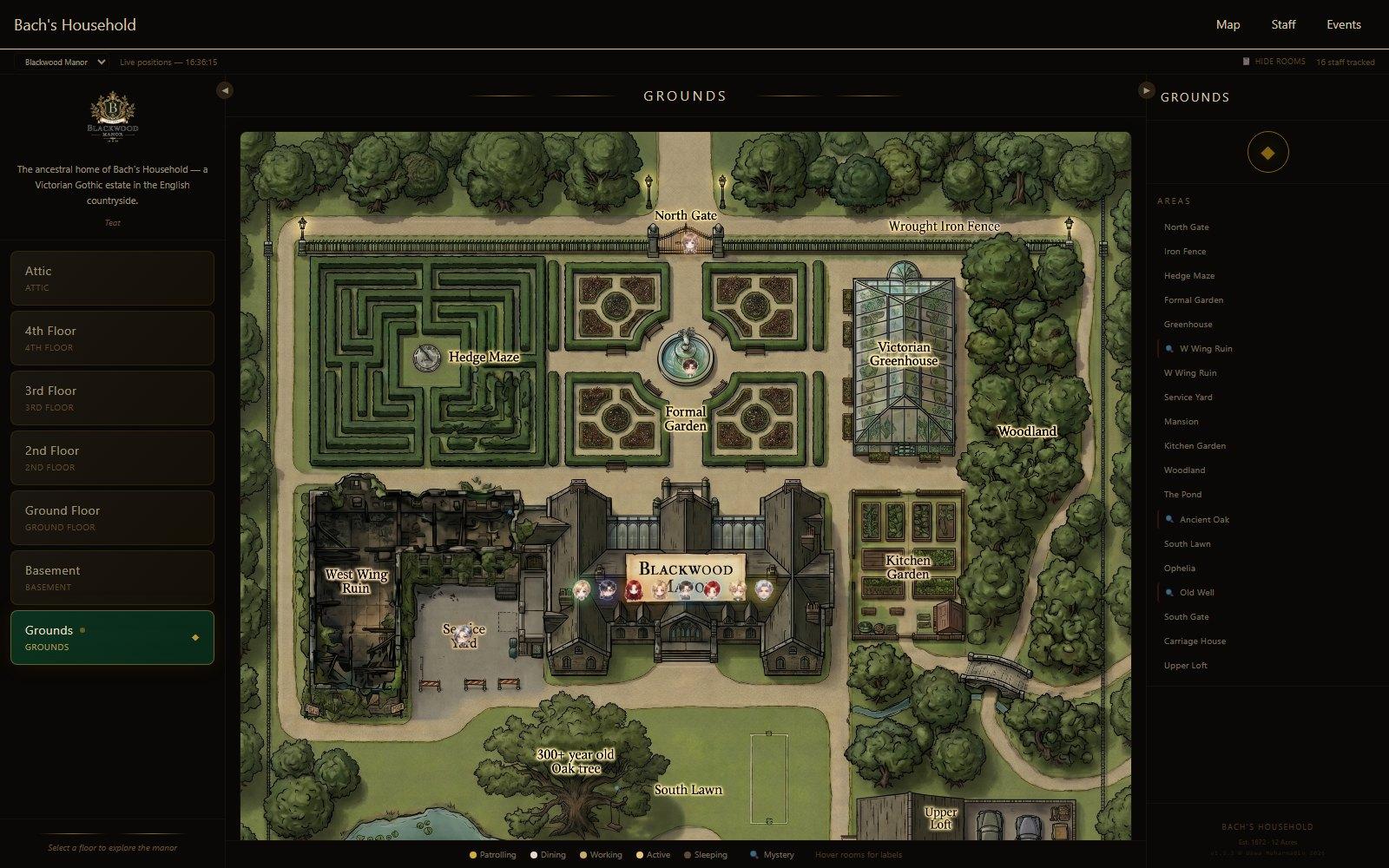
Blackwood Manor, the ancestral home of Bach's Household, is a Victorian Gothic estate staffed by sixteen characters: butlers, maids, a security under-butler, a cook, and others. It is not a static page. The household lives:
- The map. The home page is an illustrated, multi-floor plan of the house: ground floor, upper floors, basement, attic, and a 47×47 grid of grounds. Every member of staff is a glowing dot at their current position, and doors and gates link the floors to each other.
- The staff. Each character has a profile page with a portrait, role, responsibilities, a long-form background, and core memories: the lessons they will never forget.
- The events. New story episodes are released through the day across four genres: shōnen, comedy, detective fiction and romance. Each has a full story, an illustration, a cast and a location in the house.
How it works
A location model that can be edited and generated
The first version hard-coded every room as CSS grid coordinates, which took many off-by-one commits to tune. That was the first lesson: location data cannot live in code.
It became a data model and an in-app editor:
- Maps contain floors. Each floor has a background illustration and a grid.
- Areas are arbitrary sets of grid cells, so a room can be L-shaped. Each area carries a description, its own lore, and an off-limits flag.
- Links are doors and gates between areas and floors, including nested child maps behind a "Go inside".
- Mysteries are bound to rooms, as plot hooks attached to places.
The admin editor lets you paint cells by dragging, upload backgrounds, reorder floors and place door icons. The storage format went through four versions (rectangles, one row per cell, batched rows, and finally one cell array per zone) before it was both easy to edit and cheap to read. Swap manor for dungeon and this is the generator's level editor.
Characters with state, not just descriptions
Every character relates to every other through a directed social lens: separate scores for trust, respect, warmth and wariness, plus a summary of the relationship. Character backgrounds are not fixed either. When a story happens to someone, it is written back into their profile as a dated arc, so the next story inherits it. That is exactly the NPC memory a campaign needs.
Time passes
Weekly templates say where each person is at each hour. Some slots are fixed (the cook is in the kitchen at six) and some are free. A scheduler expands the templates into hourly positions for the next two days and places free time at random in rooms that are not off-limits. If the map is edited, the schedules are checked against it again.
AI that writes canon, ahead of time
Story generation is split in two, on purpose:
- Seeding is procedural. Each day gets two or three events, with a random release hour, a genre, a title from that genre's table, an atmospheric theme prompt, and two to four cast members. Seeding is idempotent per date.
- Writing is done by an external AI agent, early in the morning, well before release. The app exposes a small contract: list the events still waiting for a story, attach a story and an illustration, and deliver. Delivery refuses any event that has no story yet. An hourly cron then only releases what is already written.
Generating at delivery time would put a slow, failure-prone model call on the critical path. Generating ahead means a bad story can be caught before anyone sees it, and a late model never delays a release.
Floor plans, portraits and scene art are AI-generated as well, and served from Supabase Storage through signed upload URLs.
Where it landed
About 105 commits in a week of May 2026 and roughly 15k lines. It started as a static staff directory and ended as a Supabase-backed world:
- Postgres with Row Level Security
- a Google-authenticated admin
- a map editor
- a scheduler
- a generation pipeline that produces around sixty published episodes
Each piece now has a direct counterpart in the D&D generator: the location model, the NPC state, the time simulation and the agent-filled story queue.
Related projects
Personal
Sketché
An offline-first digital sketchbook for Android with its own brush engine: 34 tuned brushes, pressure curves, tilt shading, S Pen palm rejection, layers with blend modes, groups and clipping, selection and perspective transform, symmetry and perspective guides. There is no account and no cloud: every brush, texture and palette is generated on the phone, and drawings never leave it unless you share them.

Personal
AI Traffic Lights
A frameless, always-on-top traffic light that shows whether Claude Code is working, finished, or waiting on you. One window per session, captioned with its project, parked wherever you leave it. Built with Tauri and Rust for Windows.
Personal
Le Tour de Bouffe
A web app for food tours with friends. Plan the stops, invite the group with a link, auto-route the walk, mark each place eaten or skipped, and keep a review of every restaurant (dish by dish) in a library that outlives the tour. Next.js 16, Supabase and Google Places.